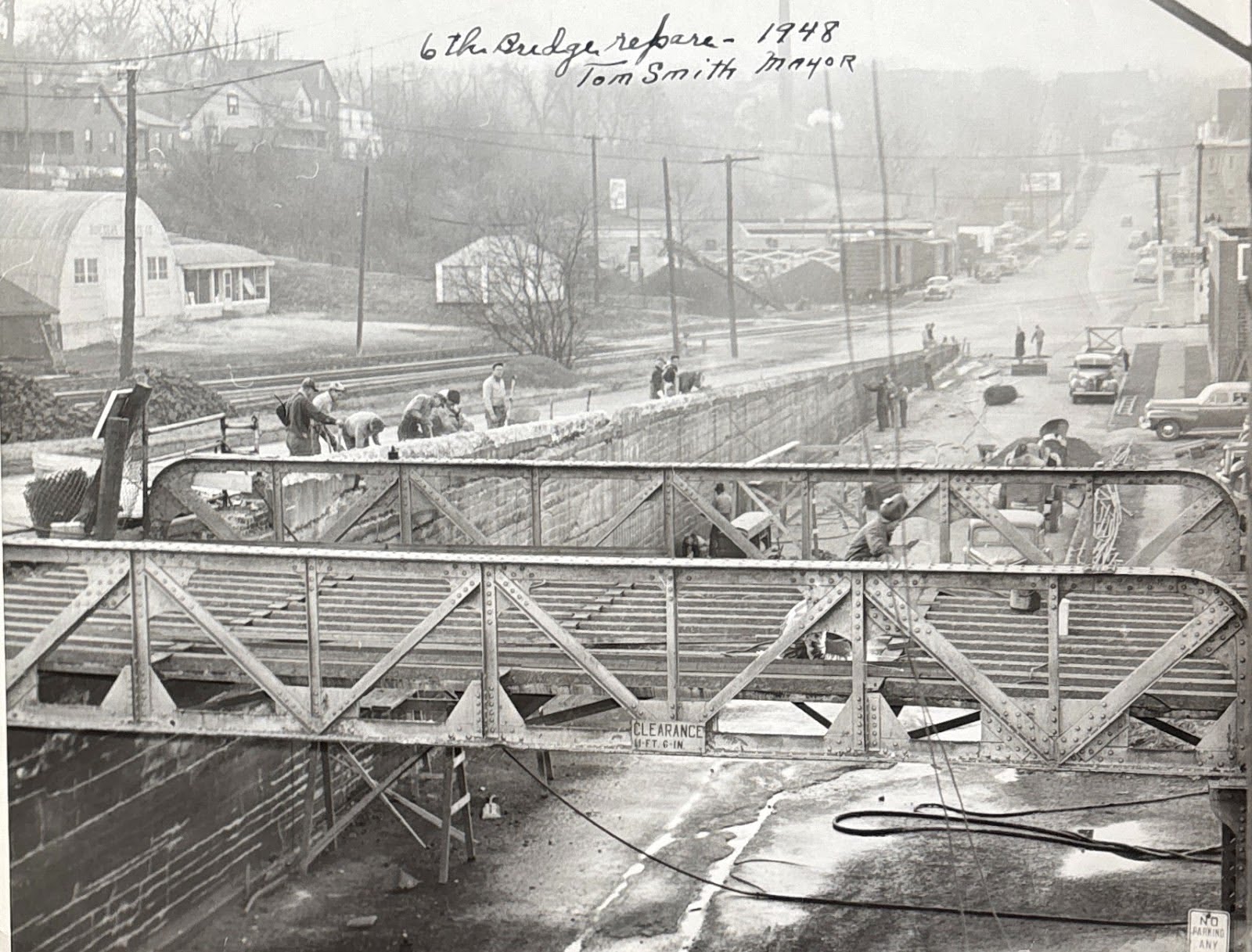
By Cora Hermann-Wickham
Burlington’s efforts to cross the busy railroad tracks at 6th Street go back to the mid-1800s. When the railroad first arrived in the 1850s, it brought new jobs and growth, but it also made it more difficult for people to move around the city. Local leaders and the Burlington and Missouri River Railroad reached an early agreement: Burlington would help pay for the new rail line, and the railroad would someday build a bridge at 6th Street once the city had grown enough to need it. The railroad would handle the bridge itself, while the city would build the ramps leading up to it.
However, decades passed with little progress. By the 1870s, the city pushed the railroad to keep its promise. Railroad officials questioned whether a bridge crossing the tracks at 6th Street was even necessary. Eventually, the company built a simple timber bridge over the tracks, but the city failed to fulfill its end of the deal, which was to construct the approaches to the bridge itself. The odd-looking structure stood stranded above the rails, too high to reach and slowly falling apart. Arguments over who should fix it dragged on until the bridge could no longer be saved. Fortunately, real progress finally came in 1884. The railroad agreed to build a modern iron viaduct if the city gave up certain parcels of land. After long negotiations, Burlington accepted the deal in 1885. Railroad engineers and the city engineer drew up plans in 1886, and construction began that spring.
The iron bridge, completed in 1886, represented a significant improvement over the earlier timber bridge. Spanning 235 feet from Valley Street to Market Street, it gently sloped downhill and combined solid railroad-style engineering with features designed for horse-drawn wagons and pedestrians. Its most striking feature was a 132-foot Pratt truss that arched over the railroad tracks. This tall steel frame provided the clearance trains needed, while a 20-foot-wide deck carried traffic across. Shorter girder spans on each end completed the structure, all of which were supported by stone abutments and steel piers anchored in concrete. The bridge included eight-foot-wide wooden sidewalks cantilevered off the sides, giving pedestrians a safe path above the rail yard. Wrought-iron components, nearly 130,000 pounds for the truss and more than 83,000 pounds for the girders, were fabricated in Chicago using iron rolled at Carnegie’s mills in Pittsburgh. Costing just over $8,000, the bridge was a major investment at the time and quickly became an important link between neighborhoods.
For nearly 20 years, the viaduct stayed mostly unchanged. But by 1903, the steep northern approach created traffic problems. City Engineer Emmet Steece developed a creative fix: he designed three 36-foot steel spans using a rare open-web pattern that blended elements of lattice and triangular truss designs. Although harder to build, the design used less material and produced a distinctive look rarely seen in Iowa. By the time workers carried out repairs in 1948, the viaduct had already been serving Burlington for more than sixty years. Both the original 1886 truss and the 1903 girders had undergone regular upkeep in the 1920s, 1930s, and 1950s. The 1948 scene reflects a long-standing city commitment to maintaining a structure that had become a familiar part of downtown life.
Today, the historic iron structure has been replaced by a modern viaduct that continues to carry 6th Street over the railroad tracks and Valley Street. The current bridge, built of pre-stressed concrete in a multi-beam design, has five spans, including one nearly 96 feet long. It includes two traffic lanes and a sidewalk on one side.