
By Cora Hermann-Wickham
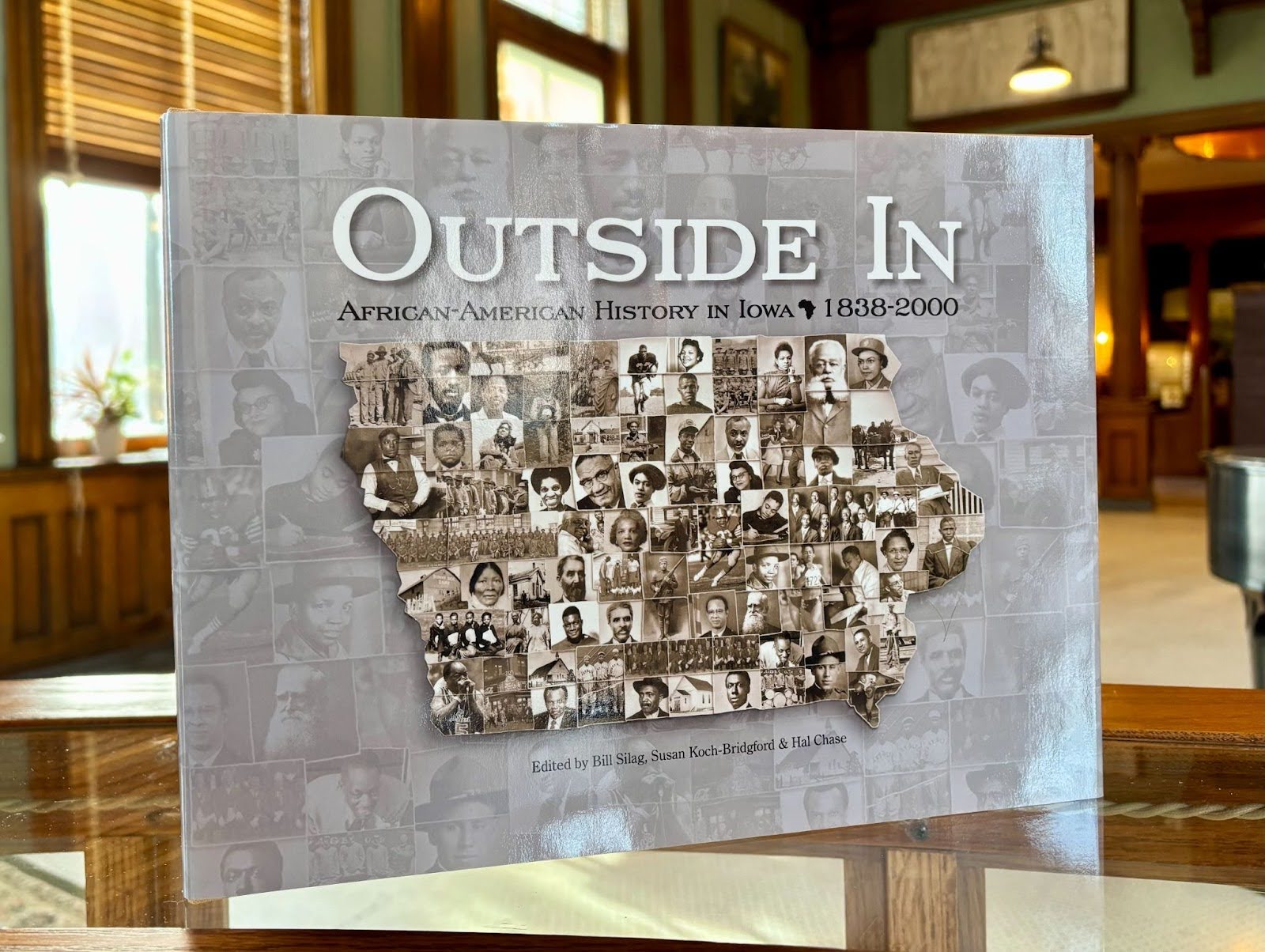
A compelling work from the collection is the book Outside In: African-American History in Iowa, 1838-2000, by Bill Silag, Susan Koch-Bridgford, and Hal Chase (Object ID: 2018.001), which offers a powerful reexamination of Iowa’s past. Challenging the long-held belief that Iowa stood at the margins of Black history, the authors demonstrate that African Americans were central to the state’s development from its territorial beginnings through the end of the twentieth century.
The book traces the African American presence in Iowa beginning in 1838, when Black settlers arrived despite laws that restricted residency, voting, and basic civil rights. It documents Black Iowans’ involvement in the Underground Railroad, their service in the Civil War, and the waves of migration that followed, all underscoring persistent efforts to claim freedom and equality. As the narrative moves into the late nineteenth and early twentieth centuries, the authors discuss the growth of Black communities in cities such as Des Moines, Davenport, Waterloo, and Sioux City, particularly during the Great Migration, when five million African Americans moved out of the rural South and into the urban Northeast, Midwest, and West.
Outside In also explores the realities of segregation, employment discrimination, housing inequality, and unequal educational opportunities, while highlighting the resilience and activism that confronted those barriers. Churches, newspapers, businesses, and civil rights organizations emerge as vital pillars of community life and political action. Labor struggles, the civil rights movement, and shifting race relations in the latter half of the century further illustrate how African Americans contributed to shaping Iowa’s social and political landscape.
Outside In does not include every story, however, as Des Moines County holds its own powerful example in the lives of Benjamin and Catherine “Aunt Kitty” Sandridge. Born into slavery in Virginia in the early nineteenth century and later enslaved in Kentucky, the Sandridges were brought to Burlington in the mid-1840s by Edward Wallace. Their freedom came at a price of $1,000 to secure their legal emancipation. Through years of hard work and perseverance, Benjamin and Catherine completed their payments around 1850. Their accomplishment earned widespread respect within the Burlington community. Even before their freedom was fully secured, they became founding members of Burlington’s Baptist congregation when it formally organized in 1849. Benjamin served the church as sexton until he died in 1855, largely without pay, while both he and Catherine contributed financially to its upkeep.
After Benjamin’s death, Catherine was granted land by the church, where she lived until 1863. Her will reflected her lifelong devotion and generosity, including a gift that helped purchase the church bell, long remembered as “Aunt Kitty’s Bell.” They are memorialized at Aspen Grove Cemetery.
Out of the Collection
Object ID: 2018.001
Book: Silag, Bill, et al., editors. Outside In African
American History in Iowa 1838-2000. State Historical
Society of Iowa, 2001.